A practical comparison for Tanzanian businesses choosing a platform for their first, or next, online store.
If you are planning an online store in Tanzania, the two names you will hear most are WooCommerce (the store plugin for WordPress) and Shopify. Both are used by millions of stores worldwide. Both can look great. But they work very differently, and the difference matters more in Tanzania than in most countries, mainly because of how your customers pay.
Tanzanians overwhelmingly pay with their phones. TCRA counted 87 million active mobile money accounts in June 2026, spread across M-Pesa, Mixx by Yas, Airtel Money and others. Whatever platform you choose has to make paying with mobile money easy, or many buyers will leave at checkout.
The short answer
- Choose WooCommerce if you sell mainly to customers in Tanzania, want M-Pesa and other mobile money at checkout, want full control and want lower monthly costs as you grow.
- Choose Shopify if you mainly sell to customers abroad who pay by card, want the simplest possible setup and are happy to pay a monthly subscription plus app fees.
For most local businesses we work with, WooCommerce is the better fit. Here is why.
1. Mobile money payments
This is the deciding factor for most Tanzanian stores. The built-in payment options on big platforms, such as Stripe, PayPal and Shopify Payments, do not support Tanzanian mobile money. You need a local payment gateway that connects your store to the mobile money networks.
Tanzanian gateways such as AzamPay, Selcom, ClickPesa and Pesapal let customers pay with M-Pesa, Mixx by Yas, Airtel Money and other wallets through a single integration. Several of them offer ready-made WooCommerce plugins, so a store can take mobile money with a plugin and your merchant account details. AzamPay, for example, publishes an official WooCommerce plugin on WordPress.org.
On Shopify, options are more limited. Some gateways, such as Pesapal and ClickPesa through partner apps, can be connected, but the choice is smaller and custom payment apps are harder to build. If mobile money is central to your sales, WooCommerce gives you more options and more control.
We cover the full setup in our guide on how to accept M-Pesa payments on your website.
2. Cost
WooCommerce itself is free. You pay for hosting, a domain, a theme or design, any premium plugins and your payment gateway’s transaction fees. Once the store is built, monthly running costs are usually just hosting and maintenance.
Shopify charges a monthly subscription in US dollars, plus paid apps for many features, plus transaction fees when you use an outside payment gateway. These costs grow as you add apps and staff accounts, and they are paid in foreign currency every month.
For a full breakdown of build costs, see how much a website costs in Tanzania.
3. Control and ownership
With WooCommerce you own everything: the website files, the database, your customer list and your product data. You can host it anywhere and change anything. With Shopify, you rent the platform. It is reliable, but you work within Shopify’s rules, and moving away later is more work.
4. Speed and local performance
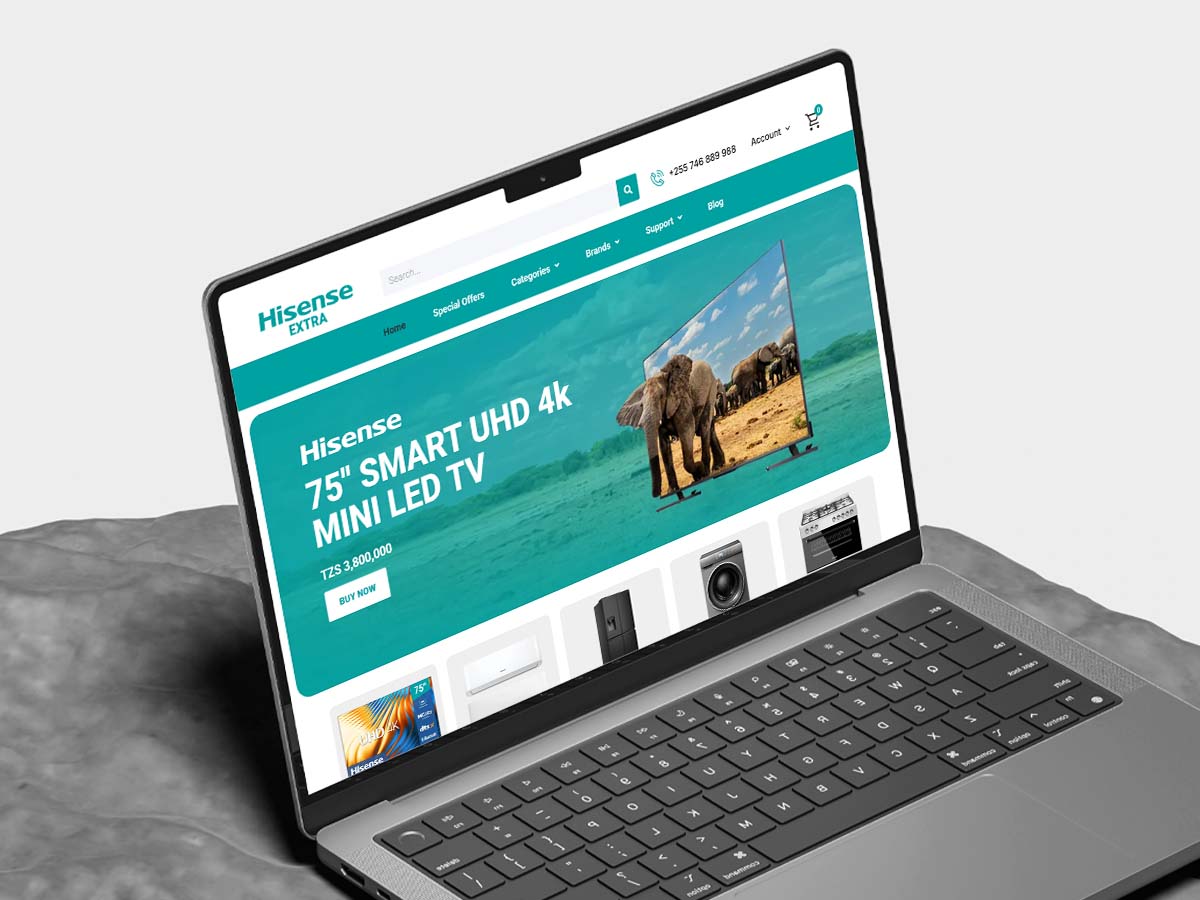
Both can be fast when built properly. A badly built WooCommerce store can be slow, which is why the build matters. The Hisense Extra store we built on WooCommerce carries over 1,000 products and loads in under a second, with a Google PageSpeed score of 97.
5. Ease of use
Shopify is easier to set up on your own, which is its biggest strength. WooCommerce has more settings, but once a store is built properly, adding products, updating prices and managing orders is just as easy for your team, and it runs on WordPress, which many people already know.
6. Marketing and SEO
Both platforms work with Meta and Google ads, product catalogues and tracking. WordPress has a slight edge for SEO and content, because it was built for publishing: blog posts, guides and landing pages sit naturally alongside your products. Content like this brings free visitors from Google over time. For more on paid traffic, see online advertising in Tanzania compared.
Our recommendation
If your customers are in Tanzania and pay with mobile money, build on WooCommerce with a local payment gateway. If you sell mostly internationally and want the quickest launch, Shopify is a solid choice. Either way, plan payments, delivery and product photos before you start building, because those decide whether the store actually sells.
Key takeaways
- Mobile money at checkout is the most important feature for most Tanzanian online stores.
- WooCommerce has more ready-made mobile money plugins from local gateways like AzamPay, Selcom and Pesapal.
- Shopify is easier to set up alone but costs more each month in US dollars, plus app and gateway fees.
- With WooCommerce you own your store and data; with Shopify you rent the platform.
- A well-built store on either platform can be fast; the quality of the build matters most.
Frequently asked questions
Can Shopify accept M-Pesa in Tanzania?
Not through Shopify Payments. You need a third-party gateway or app that supports Tanzanian mobile money, and the choice is smaller than on WooCommerce.
Is WooCommerce free?
The WooCommerce plugin is free. You still pay for hosting, a domain, design, any premium plugins and payment gateway fees.
Which is better for SEO?
Both can rank well, but WordPress makes it easier to publish blog posts and guides alongside your products, which helps bring free traffic from Google.
Can I move from Shopify to WooCommerce later?
Yes. Products, customers and orders can be migrated, and old URLs should be redirected so you keep your Google rankings.
Planning a new online store? Get a free website quote or see our web design service.
Want our guides to show up first when you search Google? Add Velocity Digital as a preferred source and our articles will appear more often in your Top Stories.